What is Architecture
2025-10-14
What is Architecture
Recall Our Definition
Here is the definition we will use. It is designed to orient us to the notion that there is not just one thing to call the architecture, but rather a set of structures that help us reason about what the system is doing.
The software architecture of a system is the set of structures needed to reason about the system, which comprise the software elements, relations among them, and properties of both. (text p.4)
The Ladder of Abstraction
Other “architectures”
- Enterprise Architecture - business structures and the processes that connect them.
- see the Zachmann framework, DODAF, among others.
- Oversee the organization’s entire portfolio of IT assets including staff, hardware (switches, PCs, servers, cloud), software (payroll systems, OS, custom software, databases).
- System Architecture - describes the people who do system engineering activities.
- Oversight of end-to-end production, including hardware components, managing subcontractors,
- ensuring the connections make sense between subsystems, preparing documents for design reviews with major stakeholders,
- understanding budgeting and legal “in the large”
- Hardware/Computer Architecture - chip and circuit design, network design, FPGAs, etc.
What does an Architect do then?
What does an Architect do then?
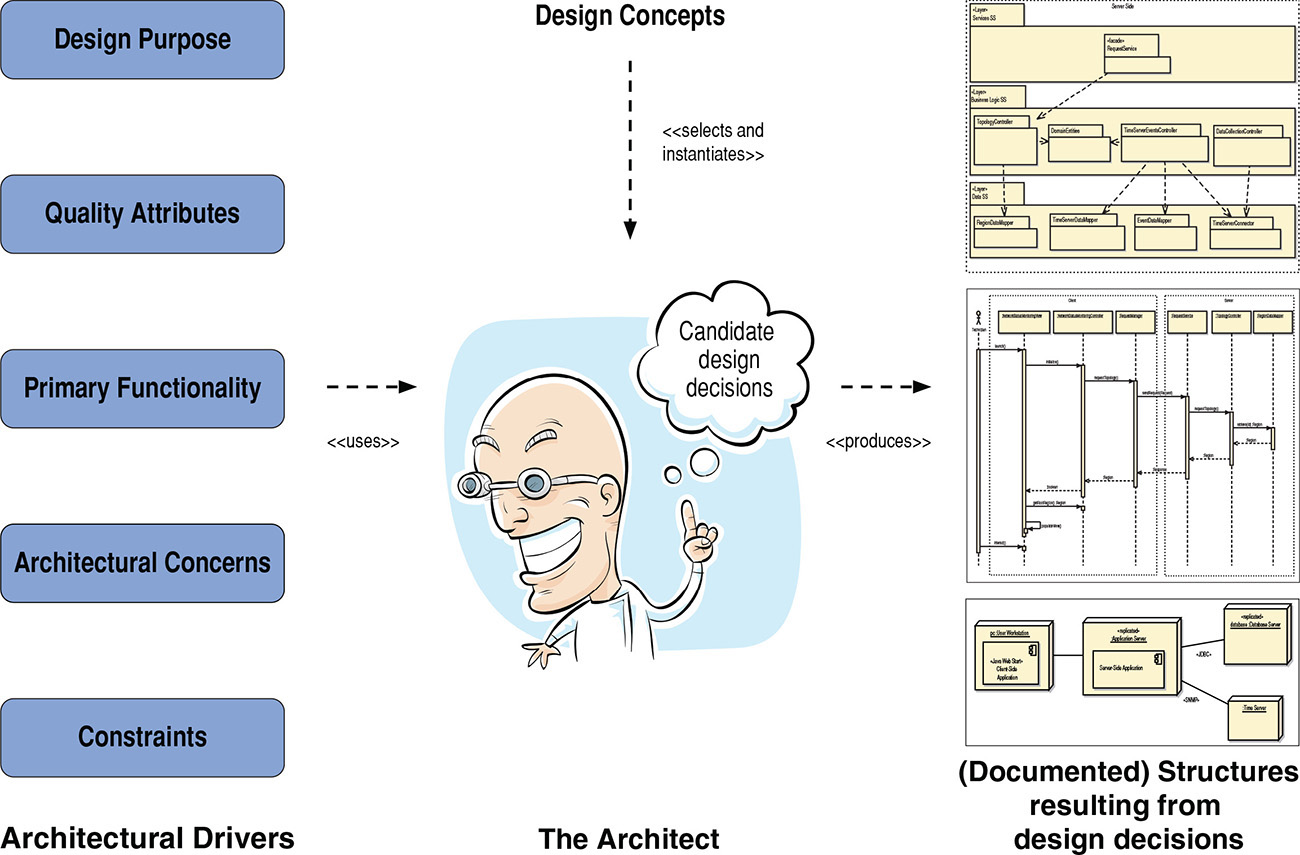
Another perspective on the Architect and their role is from Eltjo Poort at CGI:
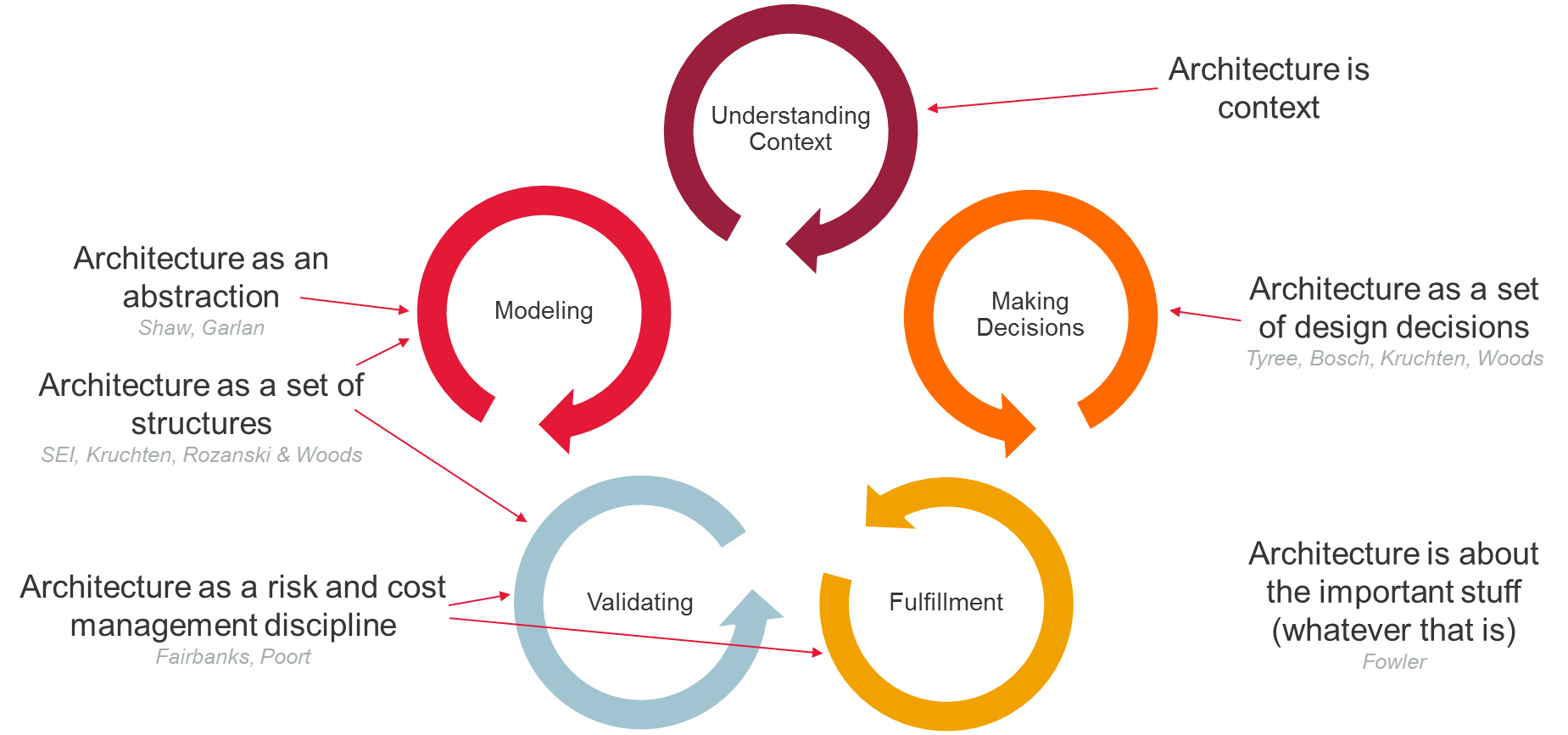
Anecdote: becoming an architect
I’m not exactly sure when I became a software architect. I do remember the first time someone else called me one. We were at an important client meeting. The client asked a really tough technical question. No one had a good answer at that moment so the project manager chimed in, Michael is the architect on this project. He’ll dig in and send you an update by the end of the week. Just like that I was a software architect.
The rush of power. The anticipation of career advancement. I am an architect! Soon a slight feeling of dread set in. I am an architect. Now what do I do? How is being a software architect different from being a software engineer? In the years since that day I’ve come to realize that being a software architect is more than just a role on a team. Architects are leaders, but being a software architect also implies a person who thinks about software design in a certain way. No matter what the title on your business card reads (mine still reads software engineer, my choice), you can be a software architect. The best development teams are filled with architects.
(Michael Keeling, “Design It!” p. 3)
Your Experiences
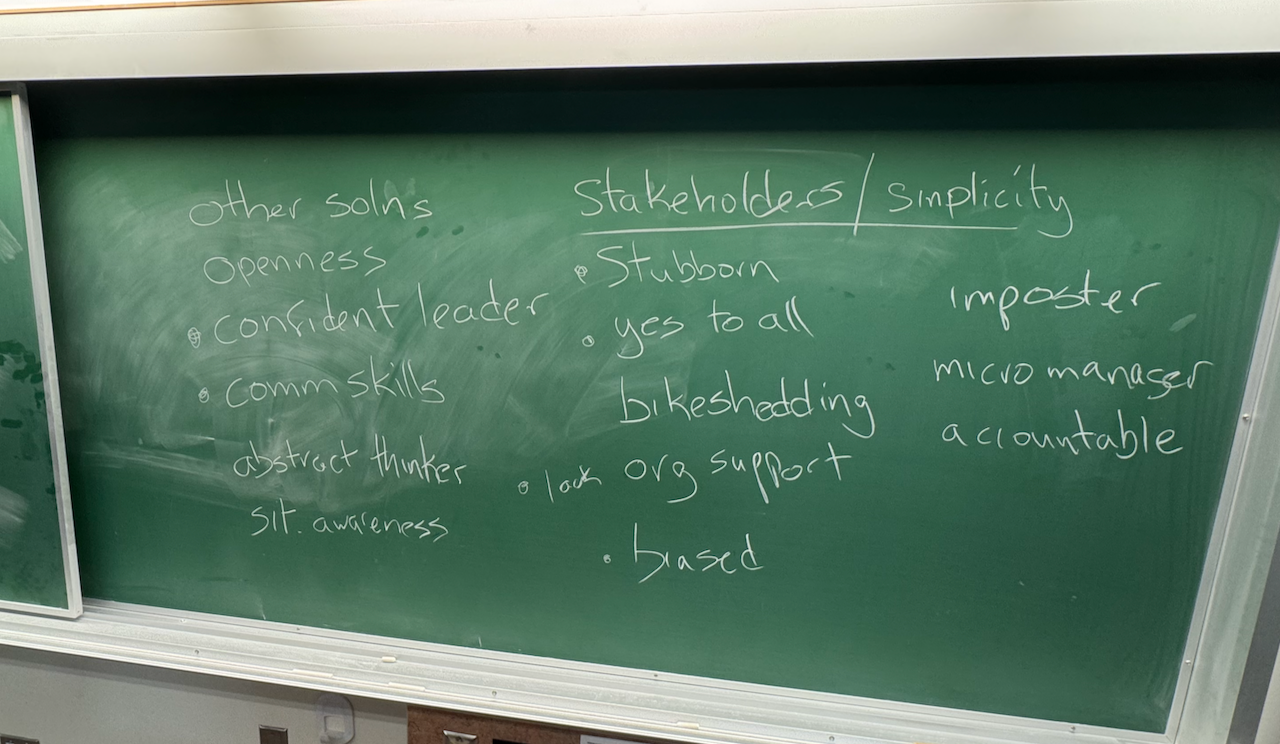
blackboard notes, line indicates bad qualities
Every software system has an architecture
- A lot of the time the architecture is implicit or tacit.
- It is captured in someone’s head, who may have left the project.
- It is an evolved version of whatever was captured in a Powerpoint slide from 2015.
- It is a market-ecture, a vision had by a business manager and explained to the customer.
- something an AI cooked up based on information available online.
The Architect Elevator
Gregor Hohpe refers to this concept when architects work on less abstract implementation challenges like writing code, then taking the elevator up the abstraction hierarchy to focus on communicating the decisions, understanding the bigger context, talking to management, etc.
For example, architects might work on a team’s design problem on a detailed level, then present that final approach to an Architecture Review Board for final approval.
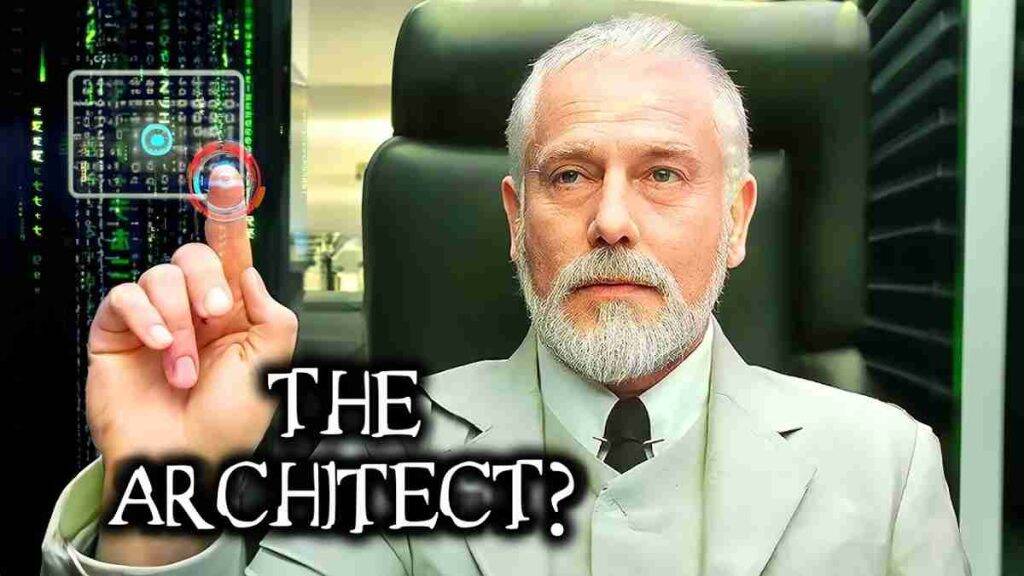
Michael Keeling is a team lead/architect/developer at IBM Kiavi. His book “Design It” is one of several books that is moving the flawed concept of an architect from “architecture astronauts” (think The Architect in the Matrix movies) to a more team-oriented, role-based definition.
A role based definition means there isn’t necessarily a single person who is “architect”, but rather a shifting set of people play that role, depending on what expertise and leadership is necessary.
Why Care
Keeling gives 7 reasons why we care about architecture.
- Divide and conquer the problem. Architecture shows us how to transition up and down the abstraction hierarchy (system purposes down to individual lines of code).
- Help manage tasks and help people work collaboratively. The architecture helps us figure out who does what.
- A common language for the system. Styles, patterns, common syntax like UML.
- Force us to look beyond “function” and into qualities.
- Connect business goals to software implementation.
- Avoid high-cost mistakes by focusing on the hard decisions.
- “The best architectures create options”. We will talk about the idea of a “architecture runway” later in the course.
The cost of change:
Feedback in SE: when a user touches your code, typically in production (maybe as an A/B test).
If we shorten feedback cycles: * we get quicker information to make changes, and * the change is cheaper.
Similarly, if we can do some upfront planning, then maybe: * we can find errors earlier, and * fix them quicker and cheaper than if the error leaks into production or testing.
In an ideal world, we make decisions at the Most Responsible Moment.
Cost of Change diagram
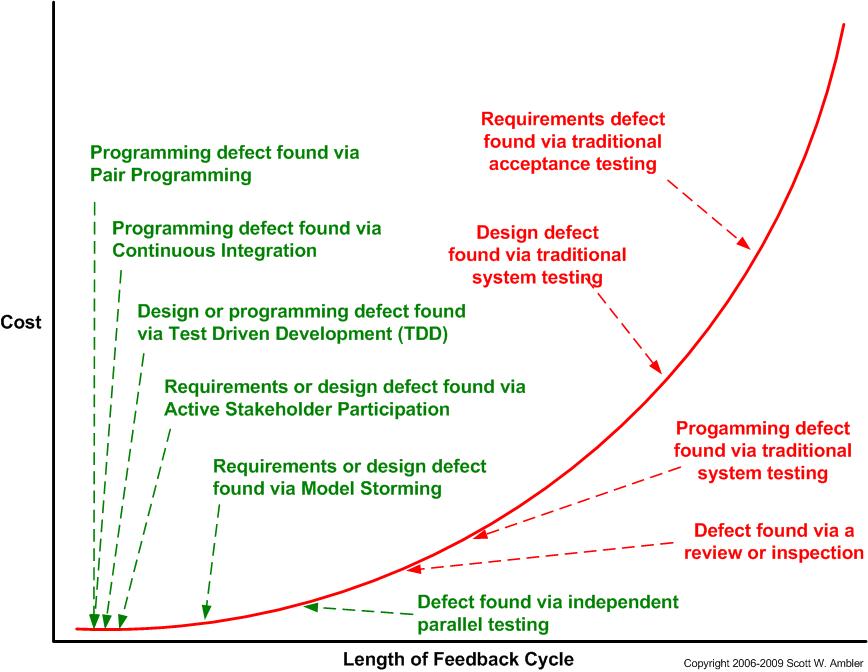
via Scott Ambler
Why Architecture from SAIP: (Chapter 2)
- Enable system quality attributes
- Reason about change
- Predict system quality
- Enhance communication
- Carry early design decisions
- Constrain implementation
- Influence org structure
- Enable evolutionary prototyping
- Improve cost/schedule estimation
- Supply a transferable model
- Assemble components
- Restrict alternatives
- Provide training
Structures Exercise
TPS: What structures do we care about (read: want to be able to reason and ask questions about) when we want to replace a Bridge?
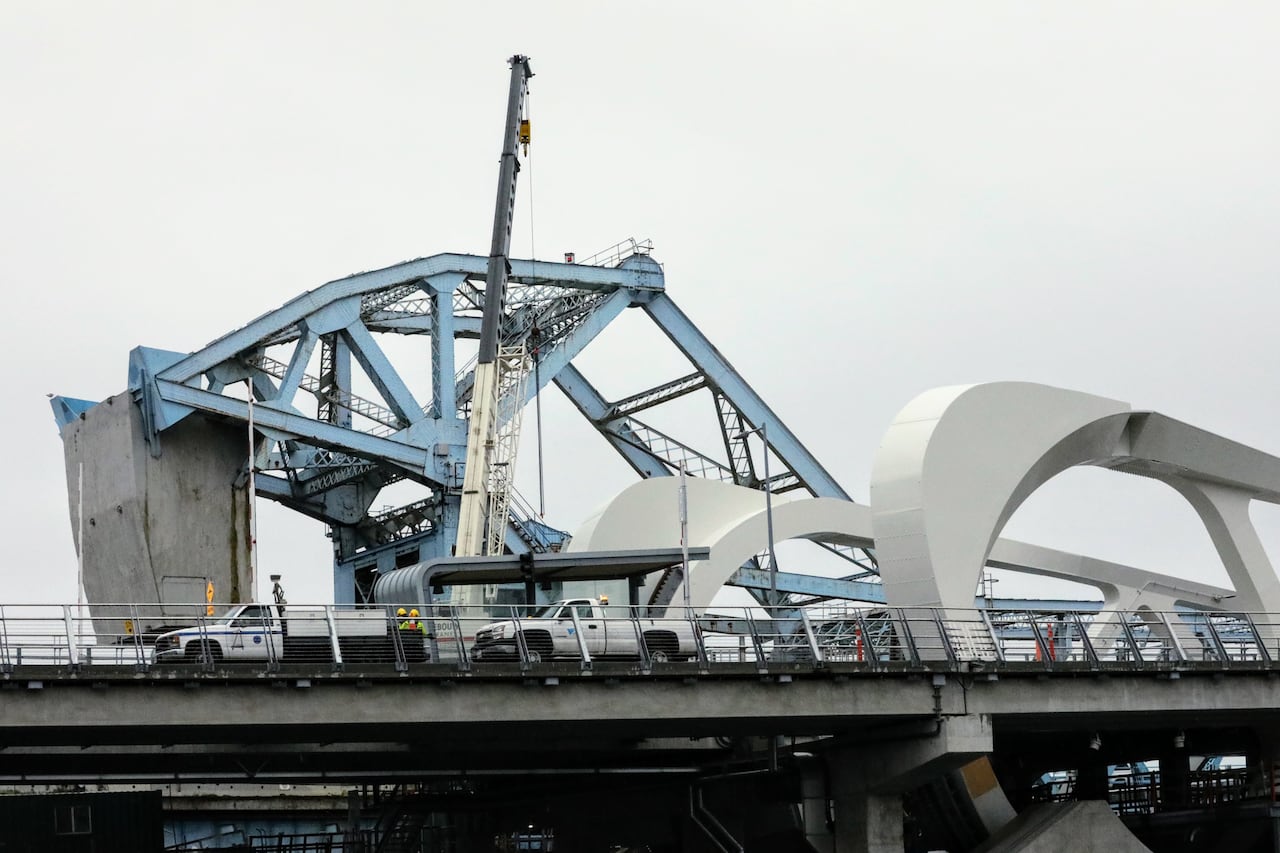
- Physical structures - can the bridge support traffic, not break down, not cost too much to maintain?
- Transportation structures - how much traffic can this thing manage? What types of traffic? Can boats get by?
- Aesthetic structures - Is it attractive? Does it make the city iconic?
- Personnel structures - Who will work on the project? When do they need to come in?
- Logistics structures - Where do the materials come from? What materials do we need?
- Financial structures - How much does it cost? What types of financing can we get?
What types of structures do we care about in building a reasonable large piece of software?
Structures according to SAIP
In the SAIP approach, the main categories of software structures are:
- module structures
- component and connector (runtime, C&C) structures
- allocation structures
We will spend more time on these in a few weeks.
Implications
- Systems have many (many) structures. We need to filter the ones we really care about.
- No one structure is the architecture.
- Every system has an architecture, which may be more or less visible in the docs.
- Important for this course and project: the diagram is not the architecture. We need information on how the diagram answers our key questions.
- We can only define whether an architecture - set of structures - is good or not, by understanding how well it meets its quality requirements, and ultimate business or mission goals.
Why “Document”
There are three major modes for creating a software model.
Models - blueprints, computer code, boxes and lines, tables of contents - are supposed to be useful abstractions when the real world is too complex to reason with.
Per Martin Fowler, we have three main modes for diagrams:
- Diagram as Sketch
- Diagram as Blueprint
- Diagram as Executable
What is good or bad about this diagram?
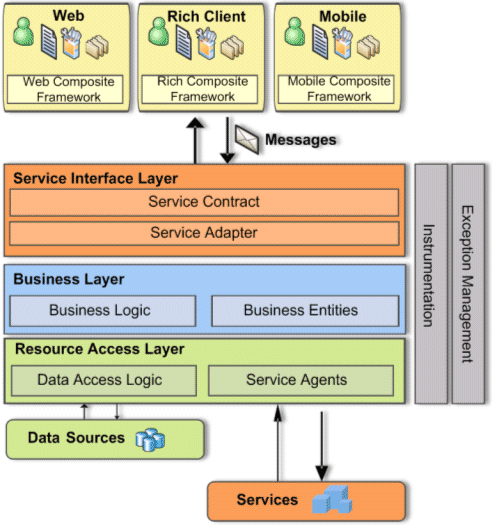
Problems
- what are we learning? There are lots of boxes? Messages are being passed around?
- The applications involved and the elements they comprise?
- The system has multiple tiers?
- The data, control, and communication mechanisms that are used?
What is missing:
- when and where do things exist?
- what is going on at runtime?
- how do we deploy this?
- what does each element do wrt requirements? responsibilities?
- what are the connections?
- what do the colors mean?
The other modes, blueprint and executable, are really about making models do more than communicate in the short term.
In the Blueprint approach, we want to hand off our models to downstream users, like architects do in the real world for buildings.
In the Model as Executable, we are actually writing the program by building the model.
This is most common where there are tight constraints on safety or security, such as in automotive.
In this mode, we use a tool like Simulink to draw block diagrams that a verified compiler can translate into safe (ish) C code.
7 Principles for Effective Documentation
- Write for the reader 1
- Avoid repetition
- Avoid ambiguity
- Organize and standardize
- Record rationale
- Keep it current
- Review the documentation
Summary
Every system has an architecture.
We need to communicate this (if it is important) to stakeholders.
Three structures seem most crucial: modules, components and connectors, and allocations.

Neil Ernst ©️ 2024-5