Modifiability
2025-10-27
Architecture Tactics for Modifiability
Definitions
The “modifiability of a software system is the ease with which it can be modified to [respond to] changes in the environment, requirements or functional specification.” (Bosch).
Synonyms include maintainability, modularity, sustainability.
Origins
In the 1960s IBM embarked on what was one of the largest software projects ever attempted, to create an operating system for their new line of mainframes. This project, OS/360, went over budget and schedule, and two influential software engineering ideas emerged from it. The first is that software isn’t something you can just add more personnel to speed up development time. This is Fred Brooks’s Mythical Man-Month book.
Laws of Software Evolution
The second is that software continually changes and needs ongoing investment to prevent it from descending into chaos. This was captured as Manny Lehman and Laslo Belady’s work on software evolution, particularly the law of continuing change.
More recently this concept has been crystallized as the notion of technical debt: the idea that short-term approaches for fixing bugs or adding new features comes at the expense of long-term sustainability of the software.
Modifiability Scenarios
The modifiability approach captured in the textbook describes this scenario as
change arrives → tactics are applied → change is made within time and budget.
Making a “change”
Note that we assume, in the modern era, that making a change means:
- Functionally correct, i.e., no bugs
- Tested
- Deployed to production
Modifiability Scenarios
What are some sample modifiability scenarios?
HomeAssistant Case Study
Home Assistant is home automation software that is open source.
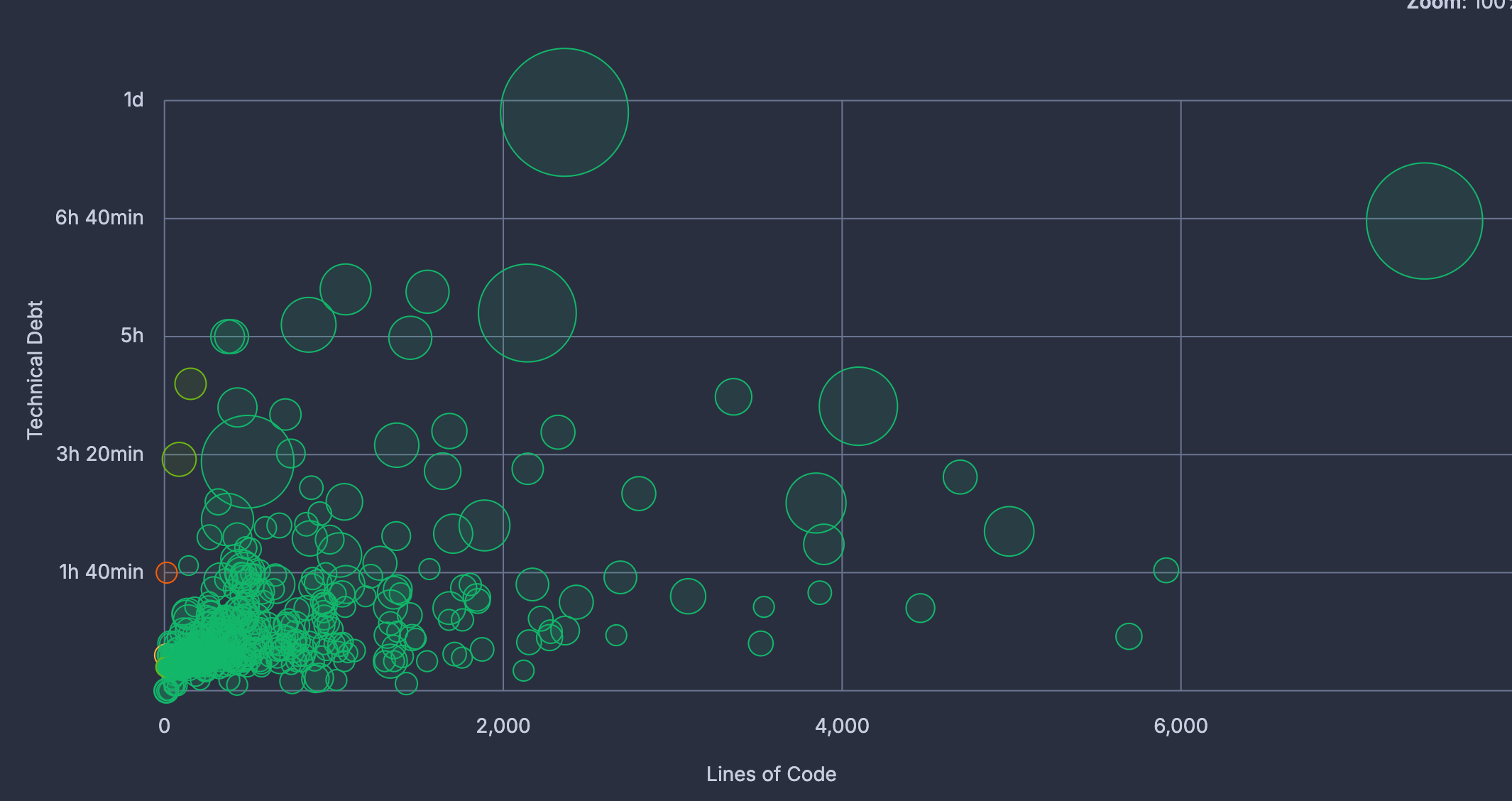
- read SonarQube analysis for HomeAssistant.
- Five minutes of exploring the report at https://sonarcloud.io/component_measures?metric=Maintainability&id=neilernst_ha_core. Focus on Measures>Maintainability
- Where should we invest 2 weeks of developer time, according to the dashboard?
- What is the long-term trend in how many maintainability issues the code has?
Home Assistant
Sample Scenarios
For HomeAssistant, examples include
- A new software version of the Philips Hue IOT lighting control system is released, with breaking changes. Home Assistant can release an update to manage this change within 2 business days.
- An exploit has been identified in the SSH package HA uses for remote access. The new OPenSSH library is deployed in 2 hrs
Sample Scenarios
- A disclosure allowing remote root access is emailed to HA maintainers. HA removes the exploit in the distribution and issues a patch online within 2 hrs.
- The current approach to packet control is too slow. A team has been researching new packet control approaches. The replacement of the old system happens within 2 weeks, and there are no breaking changes.
Software Metrics and Analytics
A big part of software engineering these days is software analytics.
This refers to the use of data science for improving and understanding the software and software process. As part of the project, you are using analytics to understand your code better.
For example, some companies measure the number of lines of code their developers added. This is generally a terrible idea, and analytics projects are usually better off measuring the code itself, rather than the people creating it.
Modifiability tactics
Tactics are approaches and patterns to improving a particular quality attribute.
Modifiability Tactics
(Chapter 7)
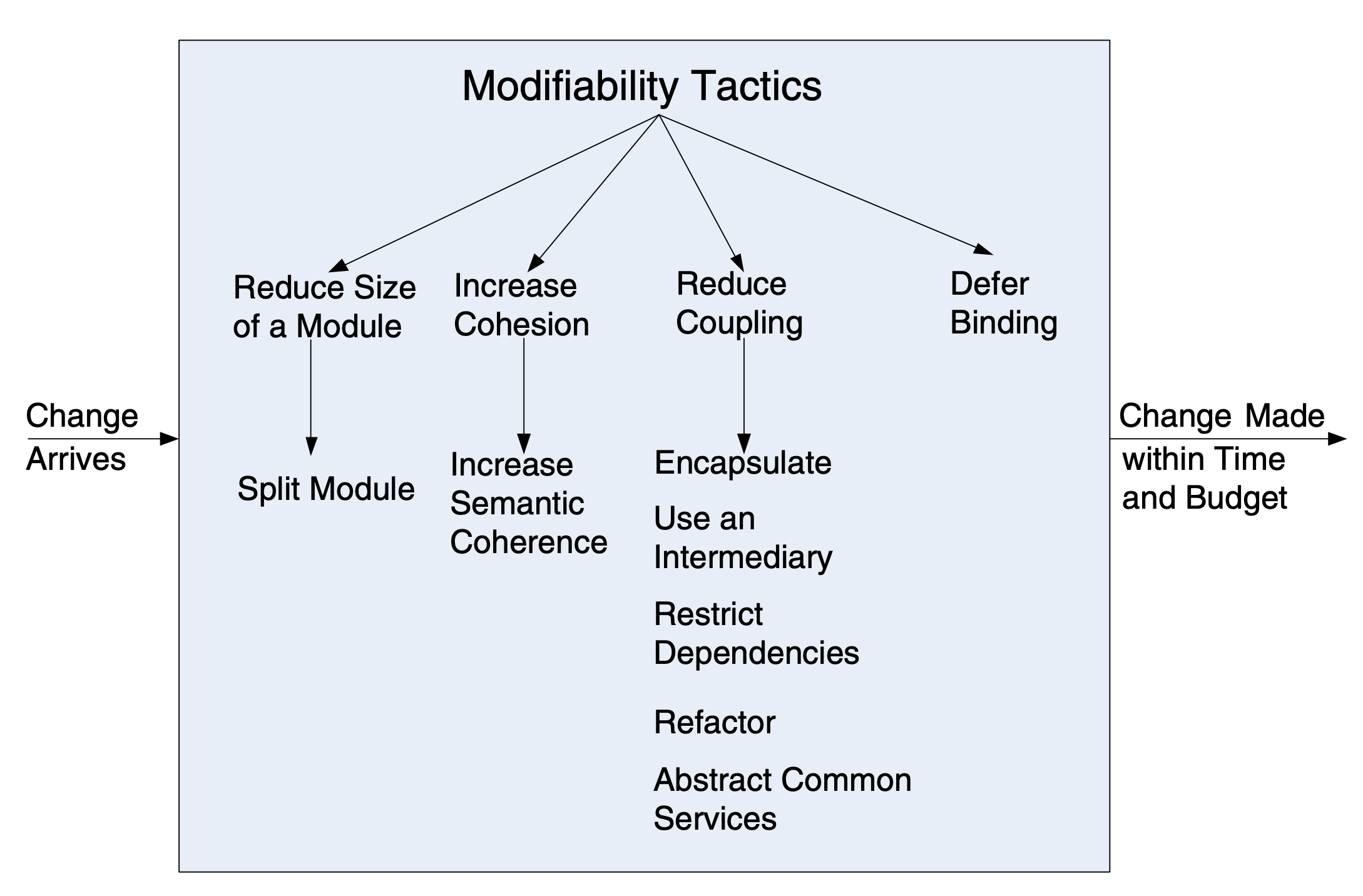
modifiability tactics
Tactics in Detail
Parameters that matter:
- coupling - decrease the cost of modifying B, if A changes
- cohesion - remove responsibilities that aren’t changing
- size - longer code is generally harder to understand, increasing change costs/time.
- binding time - it is generally a good idea to support changes late in the life-cycle, but there is a tradeoff with the cost of preparing for those changes.
Tactics
- Reduce Size/Split Module: given a responsibility, replace it with two sub-responsibilities. Each child is independently modifiable. Implementation concerns: identifying detail changes likely; how to capture the resulting coupling.
- Increase Cohesion/Semantic Coherence: move things that change together into a common location. Implementation concerns: where should the common location be; what is actually common/shared.
- Encapsulate: hide implementation by introducing an interface. Implementation concerns: once hidden, interface is a contract that must be adhered to; possible leaky abstractions.
Tactics (2)
- Use an Intermediary: decouple responsibilities. Ensures that e.g. publishers need not be aware of their subscribers. Implementation concerns: similar to Encapsulate.
- Restrict Ability to Use Modules: hide modules with visibility modifiers (private/package/public) or using layers. See Encapsulate
- Refactor: identify common responsibilities and ‘pull up’ those common elements into a single function or module. Implementation concerns: when to refactor; how common the function really is; where the common package lives.
Tactics (3)
- Abstract: parameterize common services and adapt internally to the slight differences in, for example, authenticating basic and admin users.
- Defer Binding: Ideally we bake in the flexibility to parameterize large chunks of the application. This allows us to worry about the specifics closer to when the system will be delivered. For example, we might want to avoid committing to a particular data storage approach. Some implementation approaches:
- Use dependency injection (e.g. Guice, Spring)
- Parameter and config files
- Component replacement
- Plugin architectures like Eclipse
- Pub-sub designs
- Name servers and registries
Modifiability Tactic Examples in Home Assistant
Find examples of one of the tactics in Home Assistant’s source code.
MVC and Modifiability Tactics
The paper linked to below from the SEI explains how these tactics can be implemented using architecture patterns like layering, brokers, blackboard, and MVC.
Let’s examine MVC in detail.
Forces
Forces are the context for why we choose MVC, and sources of change (stimuli) in our QAS models.
- The same information is presented differently in different windows.
- The display and behavior of the application must reflect data manipulations immediately.
- Changes to the user interface should be easy, and even possible at runtime.
- Supporting different ‘look and feel’ standards or porting the user interface should not affect code in the core of the application.
Tactics supported by the MVC Pattern
- Maintain Semantic Coherence. According to the definition, the model component contains the functional core of the application, requiring all the necessary responsibilities for those concepts to be located within the model.
- Use Encapsulation. The model component encapsulates the functional core data and functionality.
- Use an Intermediary. The controller acts as an intermediary between the input device and the model. The view acts as an intermediary between the model and the output device.
- Use Runtime Binding Views can be opened and closed dynamically, and different views can be bound to the data at different times during execution.
Code Smells and MVC
It is useful to consider how metrics for modifiability and tactics intersect. One approach is to identify particular pattern ‘smells’ that represent violations of the tactics.
Aniche et al (2018) investigated code smells for MVC architectures. They proposed the following 6 smells in MVC, using the architectural description shown below:
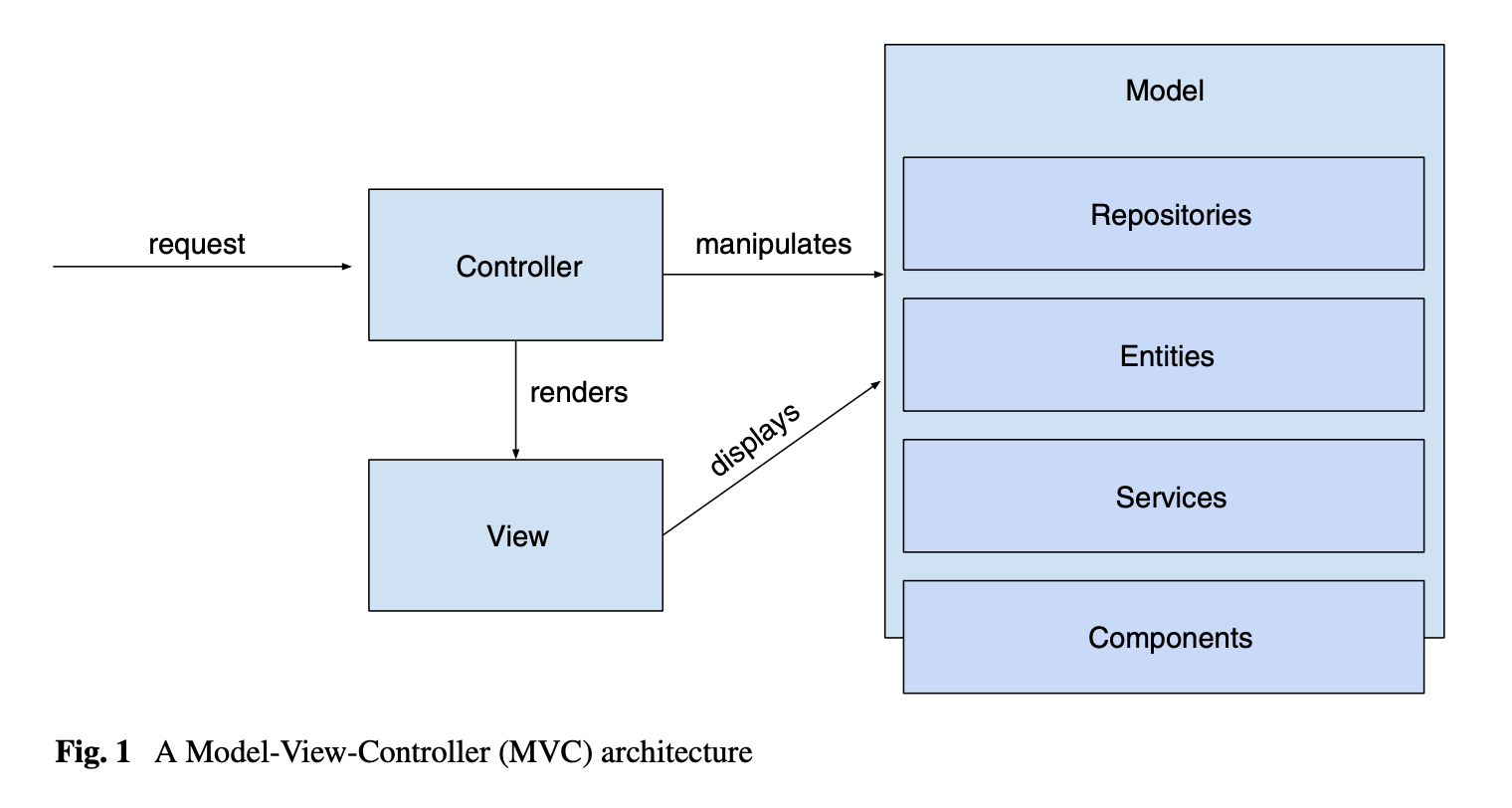
mvc arch
MVC Smells
| Smell | Explanation |
|---|---|
| Promiscuous Controller | Offer too many actions (e.g. 1000 routes) |
| Brain Controller | Too much flow control (instead of in Model/Entity/Service) |
| Meddling Service | The service directly query the database (instead of via DAO) |
| Brain Repository | Complex logic in the repository (e.g. complex SQL queries) |
| Laborious Repository | A method having multiple actions (e.g. storing more than one Model object) |
| Method Fat Repository | A repository managing too many entities (e.g. > 1) |
Summary
- Modifiability tactics help our system respond to and address changes effectively
- Modifiability is a QA that is inherent to most software systems (Law of Continuing Change)
- MVC can help (separation of concerns) but is still subject to entropy!
Further Reading
- The text draws on a longer paper published here.
- Brooks, Mythical Man-Month
- D.L. Parnas. “On the Criteria to Be Used in Decomposing Systems into Modules,” Communications of the ACM 15(12)(December 1972).
- Parnas, “Designing Software for Ease of Extension and Contraction,” IEEE Transactions on Software Engineering, SE-5, 2 (1979), pp. 128-137.
- Visser, J. (2016). Building Maintainable Software: Ten Guidelines for Future-Proof Code. O’Reilly.
- PerOlof Bengtsson , Nico Lassing , Jan Bosch and Hans van Vliet, Analyzing Software Architectures for Modifiability.

Neil Ernst ©️ 2024-5