Module 4 - Stakeholders and Requirements
2025-09-10
Stakeholders and Requirements
Stakeholders
We’ve mentioned a few times that what matters is who the system is for, not what the system does. Of course, there are multiple different sets of interested parties. These are the stakeholders.
Back to our Blue Bridge example. Who are the stakeholders in this project?
| Role | Concerns | Instances |
|---|---|---|
| Assessors | Oversee the system’s conformance to standards and legal regulation | |
| Communicators | Explain the system to other stakeholders via its documentation and training materials | |
| Developers | Construct and deploy the system from specifications (or lead the teams that do this) | |
| Maintainers | Manage the evolution of the system once it is operational | |
| Production Engineers | Design, deploy, and manage the hardware and software environments in which the system will be built, tested, and run | |
| Suppliers | Build and/or supply the hardware, software, or infrastructure on which the system will run | |
| Support Staff | Provide support to users for the product or system when it is running | |
| System Administrators | Run the system once it has been deployed | |
| Testers | Test the system to ensure that it is suitable for use | |
| Users | Define the system’s functionality and ultimately make use of it |
Rozanski and Woods book on architecture
Let’s fill that in for the Blue Bridge example.
Why do we care about who the stakeholders are? These are the people with varying levels of need and interest in a system.
At the least, we need to think about who the documentation stakeholders are. If we are doing a system design, we need to think about who should be consulted.
And at the end of the project, we evaluate success with respect to stakeholders.
A good architecture is one that successfully meets the objectives, goals, and needs of its stakeholders. (Rosanski and Woods)
Some stakeholders are more important than others. e.g., mgmt vs end users.
Stakeholder users wanted the search function to find the result in less time (it was taking minutes). They were used to Google speed (milliseconds), and yet, solving these problems turned out to be very complex.
Our documentation needs to do different things for different people. Who the stakeholders are will help us determine that.
Requirements, ASRs, and Quality Attributes
Requirements
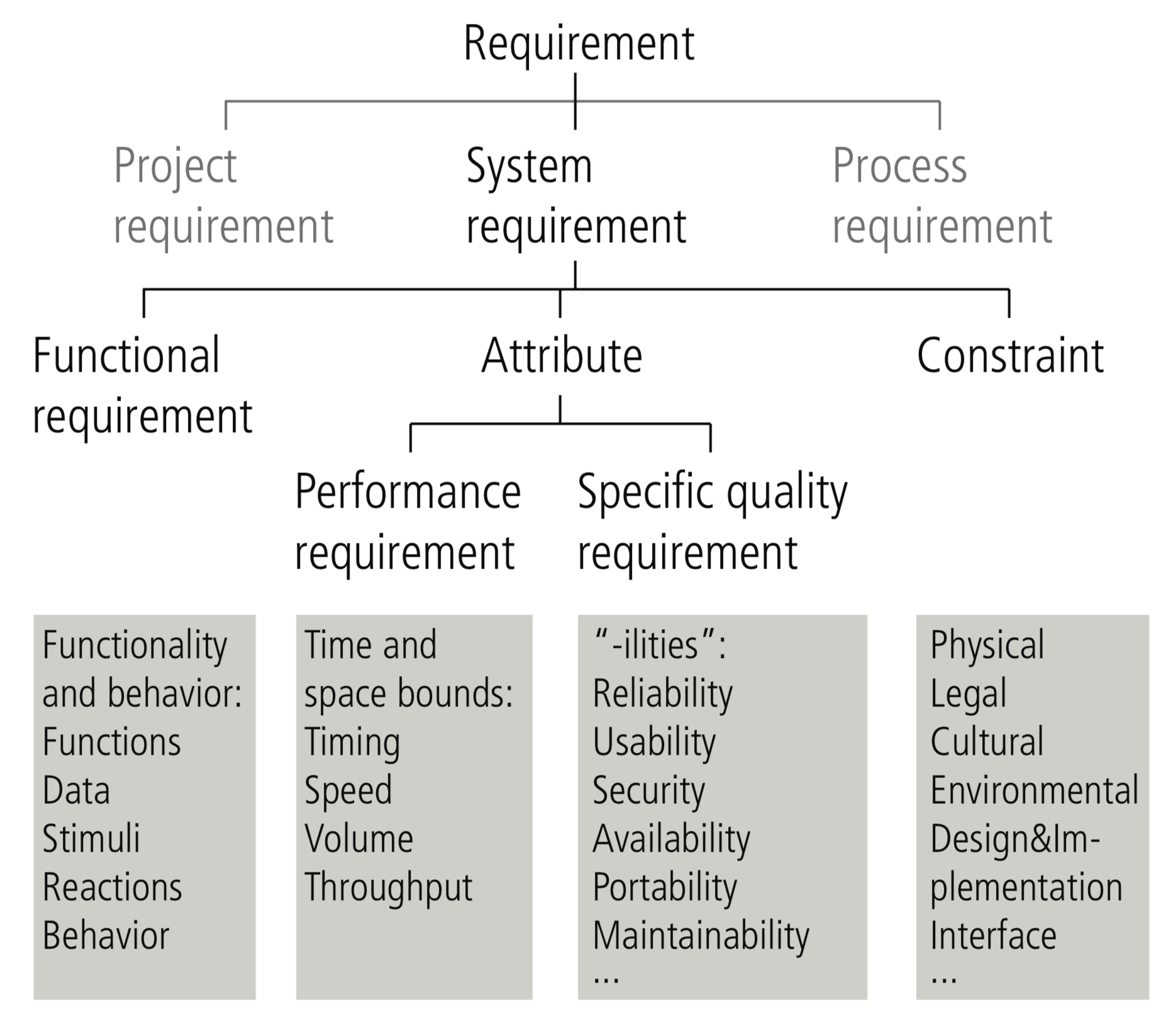
Let’s classify requirements along the lines of Martin Glinz’s paper “On Non-Functional Requirements”.
User Stories
User stories help capture the functionality the software should provide.
User stories are a ~3 sentence description of what the software should do
User Stories
- Conversation starters
- should only provide enough detail to make a low-risk estimate of how long it would take to implement (1,2 or 3 week estimate in “ideal development time”)
- written in the customer’s language, from the customer’s point of view
- Typically take Role-Goal-Benefit form: > “As a <ROLE>, I want to <GOAL> in order to <BENEFIT>”
As a student, I need to login to Gitlab in order to finish the assignment
Product Backlog Item
User Story also
- has a description of the story providing additional detail
- specifies acceptance criteria that defines what is meant for this feature to be DONE
- provides estimate of the required effort (story points)
INVEST (for a good user story): Independent, Negotiable, Valuable to users or customers, Estimable, Small, Testable
Example: User Story
As a job company, I can use my credit card so I can pay for postings. (A job company can pay for posting with a credit card.)
- Note: Accept Visa, MasterCard, American Express. Consider Discover.
- Test: (on the back of the story card)
- Test with Visa, MasterCard and American Express (pass) Test with Diner’s Club (fail)
- Test with good, bad and missing card ID numbers.
- Test with expired cards.
- Test with over $100 and under $100.
Example: User Story & Test
As a Creator, I want to upload a video from my local machine so that any users can view it.
Note: Accept Visa or MC. Consider Discover card.
Test:
- Click the “Upload” button
- Specify a video file to upload.
- Check that .flv, .mov, .mp4, .avi, and .mpg extensions are supported. Check that other filetypes aren’t able to be uploaded.
- Check that files larger than 100MB results in an error.
- Check that movies longer than 10 mins result in an error.
- Click “Upload Video”.
- Check that progress is displayed in real time.
ASRs
- Requirements define expected behavior, ideally in concrete (yes/no) terms.
- Architecture provides an analysis model to predict behavior of the eventual system
- Properties (e.g. via testing) show actual behavior, which we analyse to determine satisfaction of the requirements.
Modifiability
Let’s look at an example with Modifiability.
The Architecturally Significant Requirements are the ones with wide impact on the system.
QAS
The first step is to find the ASRs.
For our purposes we will make the simplifying assumption that they are most often related to quality attributes (Modifiability, Performance, Usability, etc).
We tend to focus on the features and functions clients want, and leave quality to the end.
In order to make our quality requirements more tangible, we will work on scenarios that test our system qualities.
Utility trees
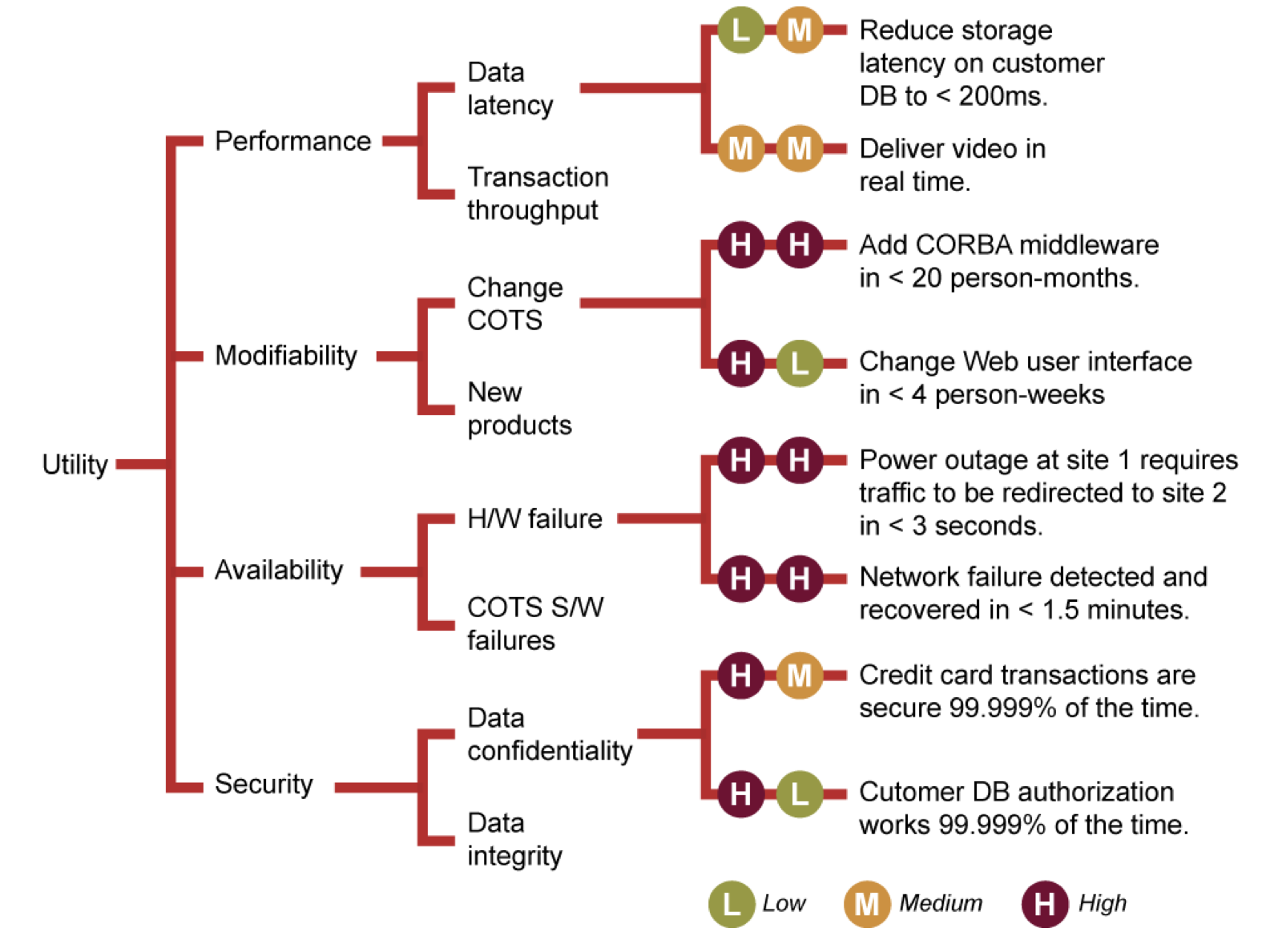
Quality attribute utility trees: mechanism for translating the business drivers of a system into concrete quality attribute scenarios.
A utility tree shows the prioritization of quality attribute requirements, realized as scenarios.
The utility tree serves to make concrete the quality attribute requirements, forcing architect and customer representatives to define relevant quality attributes precisely.
Utility Trees
Those scenarios rated high in business importance and high in technical difficulty provide the most critical context against which the architecture can be analyzed.
These scenarios are candidates for the ASRs.
Utility trees are specific to the project you are working on.
Deriving QAS from Utility Trees
One way to figure out a Utility Tree is to conduct a workshop with stakeholders to elicit the important business drivers/goals, figure out the proposed architecture, and identify the key architectural drivers.
An architecture driver is a key decision that will influence what the system can and cannot do.
Presentations for Deriving Scenarios
Ideally, we would get a long presentation from a knowledgeable business person for the first, the architect would show us the plan, and then all of the stakeholders would help prioritize key scenarios. However, we don’t have any of that.
Our business drivers will have to come from your analysis of the stakeholders and the system. And the architecture decisions are things you will have to work out.
Exercise
We are going to walk through a quick utility tree exercise.
As I briefly state the business case, write down things you feel are important about this system wrt architecture.
Business Presentation
- Canada’s customs agents are responsible for (among other things) ensuring foods imported into Canada are safe for Canadians.
- To do this they require importers to declare what they are importing. In some cases - like when the importer is new, or had previous issues - a physical inspection is conducted.
- Sorting out who the importers are is complex. They change business names, they have different offices, and the names may be in non-English or French character sets.
- We also want to ensure our partner agencies, for example at the provincial level, can easily access our data.
- Keeping business flowing is a big concern. We do not want to block the border while we physically inspect every truck, train, and ship container.
Architecture Presentation
As I sketch the architecture approach, write down the key business goals and quality attributes you hear being mentioned (perhaps implicitly; remember the project will not necessarily use the same jargon).
I sketched out a brief runtime architecture diagram.
Architecture Questions
To help identify the risks and drivers of this system, I want you to formulate some exposition questions you would have if you were helping to analyze this approach for its technical soundness. What questions would help find potential problems and omissions?
Deriving architecture questions
In groups of 3-4,
- rapidly generate a list of questions. Don’t stop to analyze the questions; just get a bunch on paper.
- Erase unpromising questions or scratch them off.
- Underline the most useful or exciting questions.
- Prepare one of those to share with the class.
Architecture Drivers
In your group, compare notes on the last two presentations and identify the key architecture drivers you think this new system has.
Scenario Generation
For each of the drivers, propose a scenario that will show how well the architecture drivers will support the scenario. Scenarios are intended to map to (satisfy) business drivers.
Scenarios
Scenarios have these parts:
| Aspect | Details |
|---|---|
| Scenario Name | |
| Business Goals | |
| Quality Attributes | |
| Stimulus | |
| Stimulus Source | |
| Response | |
| Response Measure |
- business goals: the impacted business goals
- quality attributes: the key QA involved in this scenario
- source – an entity that generates a stimulus
- stimulus – a condition that affects the system
- response – the activity that results because of the stimulus
- response measure – the measure by which the system’s response will be evaluated
We then worked out a scenario in class to show the template.
The textbook has good examples on the inside front cover.
A QAS is like an acceptance test or system test. It allows you to see to what extent the proposed design will meet the scenario.
Utility Tree
Once you have a few scenarios, you can begin to group them by quality attribute.
Furthermore, we need to prioritize our scenarios because we can’t fix them all.
We want to give the stakeholders the 5 or 6 scenarios that we feel (that is, the stakeholders and the review team) are most important to the business (H), and most difficult to fix or implement (H).
Summary
- To build a good system architecture, need to know who cares (stakeholders).
- Capture their needs as requirements.
- Next, find the architecturally significant requirements
- From these, derive scenarios that can test the proposed architecture (or existing system).
References
- https://www.viewpoints-and-perspectives.info/home/stakeholders/

Neil Ernst ©️ 2024-5